















For most marketing leaders and business owners who read this, you probably feel like you’re dealing with 87 different issues at the same time.
We all want to make sure we are getting the right results. So we work harder, fix the website again, crash course on the latest tick tok dance moves and cat videos that convert. We get all in the weeds and just react.
This isn’t in your mind. It’s real. Your 87 issues are real.

And friends, I get it.
I’ve been there. My office was a revolving door for many years…
- I was trying to shoulder too much…
- Who sees the big picture when everyone else is stuck in the weeds.
- Who asks sharper questions instead of scrambling for answers.
- Who helps people know what to do next.
Sound familiar?
Here’s what I eventually figured out, somewhere in the 20 years of running my own agency and working with hundreds of small to mid-sized businesses:
Most teams don’t have 87 different problems. They have four.
And when you can name them, and really see them clearly… everything gets simpler.
You Are Not Alone
Let’s acknowledge something important. The chaos you feel isn’t a reflection of your effort, talent, or skill.
A study by LinkedIn showed that 90% of sales and marketing teams acknowledge misalignment across strategy, process, content and culture — and that it costs companies an estimated $1 trillion annually due to poor coordination.
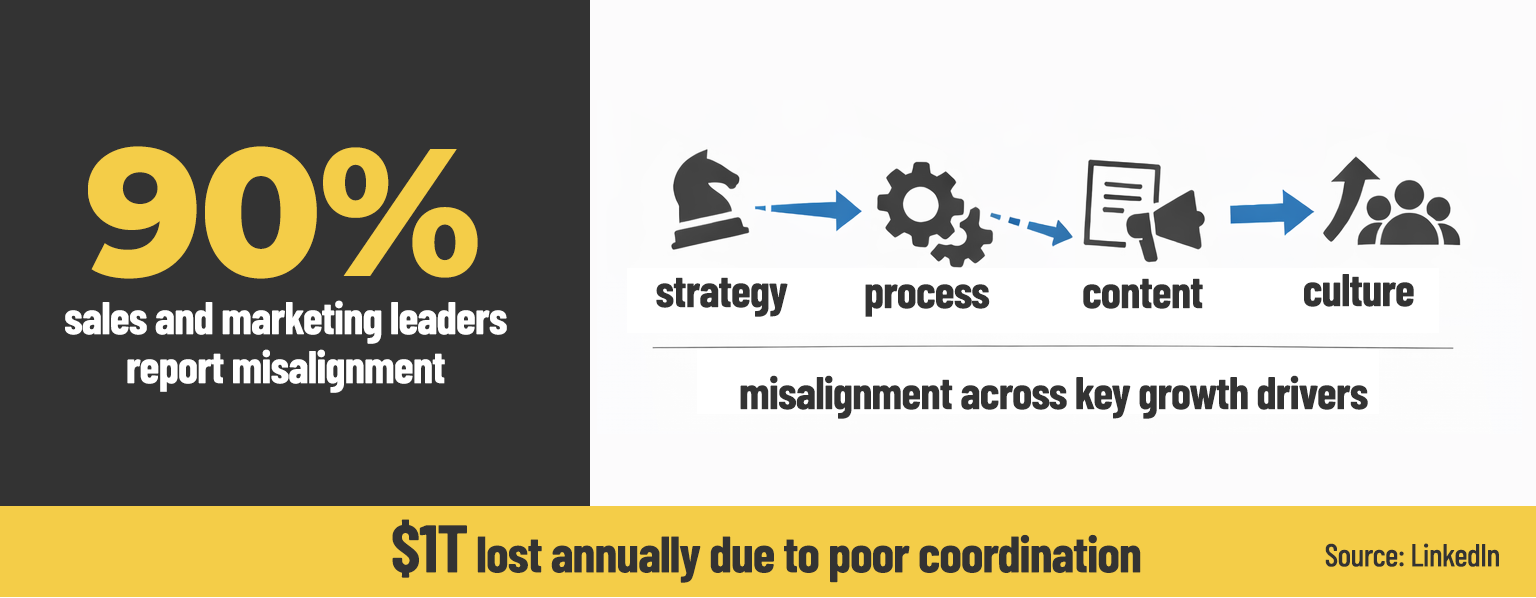
One trillion dollars. Most of it from companies full of smart, hard-working people doing their best — while treating symptoms instead of root causes.
Naming the right problem is where it starts.
The Four Struggles
In every company we talk to, we see the same four struggles at the root of their issues with sales and marketing results. Any one of these can stall your results — no matter how hard everyone is working. And yet most teams are experiencing several.
Struggle #1: Choppy Seas
Imagine your team is out on a small boat in a big ocean. The waters are rough — the market is changing fast — and when you look around, you realize not everyone is rowing in the same direction.
Your two or three strongest leaders might be rowing like mad — each in a completely different direction. Others are watching the disconnect, wondering if they can even help.
Ask your three most senior leaders what the top priority is right now. You’ll likely get three different answers. Everyone assumes alignment. Almost no one has it.
Leaders with Choppy Seas say: “The market is changing fast, and not everybody is rowing in the same direction.”
Take a manufacturing company I worked with — three-person leadership team, all smart, all committed. Sales was focused on landing large accounts. Marketing was building brand awareness for a new audience. Operations was pushing for process improvements that would only matter once the team grew. Nobody was wrong. Nobody was aligned. Every initiative competed with every other initiative for time, budget, and attention. Nothing compounded.

Struggle #2: Overload
This one shows up everywhere, and it’s the struggle I know most personally.
 In smaller teams, one person is often carrying both sales and marketing. Everything lands on their desk. In larger teams, overload still happens — usually when a leader tries to delegate, doesn’t get what they need, and pulls the work back in. “If I want it done right, I have to do it myself.”
That works for about a week. Then the weight becomes too much, and you’re too buried in the weeds to lead at a high level.
Meanwhile, people on your team have real talent sitting mostly idle — not because they don’t want to contribute, but because no one has figured out how to unlock it.
Leaders with Overload say: “It feels like 1-2 people are trying to shoulder too much alone.”
I said that about myself for years.
Struggle #3: Reactive
This is when it feels like you’re shooting from the hip.
You’re trying tactics, reading about trends, testing new things. But your inbox and feed are full of ideas you haven’t tried yet. Just as soon as you roll something out, you start feeling anxious about ten other things you aren’t doing.
Reactive teams feel busy. But busy isn’t effective. Without a clear plan guiding what you do and why, every new idea competes for the same limited time and budget. Nothing builds. Nothing compounds.
Leaders who are Reactive say: “It feels like we’re often shooting from the hip with our sales and marketing.”
I worked with a professional services firm — talented team, good intentions — but their marketing plan was essentially “do what we did last year, plus whatever ideas come up in our weekly meeting.” No priority filter. No way to say no. They weren’t lazy. They were lost.

Struggle #4: Flying Blind
You’ve got data. Dashboards. Reports from your website, social media, ads, SEO tools, and a few consultants who each gave you a different stack of charts.
And you’re still making decisions based on gut — not because you want to ignore the data, but because finding the actual insight feels like searching for a needle in a haystack.
So you fly the plane based on feel. That seems manageable until the storm rolls in, or you realize you’ve been pointed in the wrong direction and don’t know for how long.
Leaders who are Flying Blind say: “We make decisions based on gut, and we struggle to measure and track what matters most.”
This usually isn’t a data problem. It’s a clarity problem. Most teams don’t need more data. They need fewer metrics — the right ones, watched consistently, connected to real decisions.

The Pattern
“Most teams don’t have 87 different problems. They have four.”
 Choppy Seas — Leaders rowing in different directions. Everyone assumes alignment. Almost no one has it.
 Overload — One or two people carrying too much. Others have untapped talent sitting idle.
 Reactive — Shooting from the hip. Feels busy. Nothing compounds.
 Flying Blind — Drowning in data. Starving for insight. Decisions default to gut.
These four struggles are symptoms. They surface when something more fundamental is missing underneath. The good news: by strengthening the right foundations, all four can be addressed. The 87 problems don’t each need their own solution.
Which Struggle Is Costing You the Most?
If you read through these four and found yourself nodding, that’s your starting point.
Here’s the good news: it’s not 87 problems. It’s four. And when you strengthen the right things underneath each one, the 87 issues start to fall away on their own.
Those “right things” are four fundamentals that every effective marketing team needs to get right. I’ll cover exactly what they are — and how each one maps to a struggle — in the next article.
Read Next: The Four Fundamentals
Or if you’d rather talk it through now, we’re happy to help you figure out which struggle is costing your team the most — and where to start fixing it.
Want to go deeper?
- Go Deeper → The Four Fundamentals: The system that addresses each of the Four Struggles
- Related Problem → The Strategy Wall: Why most marketing problems start at the wrong level
- Get Practical → The Wheel: Where exactly is your marketing breaking down?