















They had done everything right.
New photography. A redesigned website. A LinkedIn ad campaign that looked sharp enough to stop the scroll. They’d invested real money and six months of internal effort to get it all done.
When the campaign went live, everyone was proud of it.
Six months later, the numbers hadn’t moved. Leads were flat. The pipeline empty.
So they called us.
One of our strategists started asking questions — the kind of questions that probably felt basic at first.
- Who exactly are you trying to reach?
- What problem are you solving for them?
- How do you describe your core offer?
Within twenty minutes, something became clear.
Eighteen months earlier, this company had shifted their focus. They’d moved away from one type of client and leaned into a different market. Smarter move, bigger opportunity. But nobody had gone back to revisit the foundation — the targeting, the positioning, the core offer. The new campaign had been built on top of the old one, like fresh paint over a cracked wall.
The campaign wasn’t the problem. It’s that it was built on the wrong business strategy. It would be like having a beautiful home, and obsessing over the landscaping and spotless windows, not noticing that the foundation is crumbling.

Building Campaigns From The Ground Up
 There are three levels to a marketing strategy. Think of it like a wall, a bunker, a fort you build before battle. The wall has a purpose. From behind it, you do tactical things to accomplish a result. But the wall has to be built from the ground up.
Level One: Business Strategy
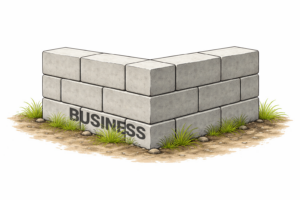 This is the foundation. Before you think about campaigns or channels or content, you need clarity on three things:
- What are we selling?
- Who is it for?
- What do we want them to do?
Maybe these feel like questions that should already be answered. And often, leadership will tell you they are. But in my experience, sitting across from leadership teams for years, this level is shakier than people admit.
Ask ten leaders at the same company to describe the ideal customer, and you’ll often get eight different answers.
The foundation looks fine from a distance. Get close enough to ask questions, and the cracks show.
Level Two: Marketing Strategy
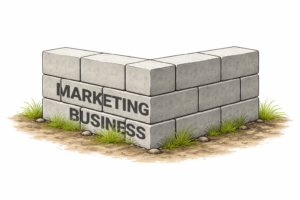
Once business strategy is locked in, you plan how to execute it.
- How will we reach our target audience?
- How will we generate leads?
- Which platforms and channels make sense?
This is where most strategic conversations happen. Budgets, channels, campaigns. The problem is that these decisions are only as good as the foundation beneath them. A brilliant marketing strategy built on shaky business strategy is still going to fail.
Level Three: Content Strategy
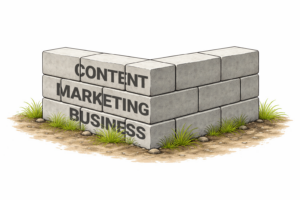 With levels one and two in place, you get to ask the creative questions:
- What do we say?
- How do we say it?
- How do we make it resonate with the right people?
This is the most visible layer. The writing, the design, the photography, the ads. It’s the part that gets the most attention — and, unfortunately, it’s the part most teams start with.
The Most Common Mistake in Marketing
Too often, marketers skip straight to Level 3. They jump from an idea, to how they’ll convey it on a flyer, digital ad, or landing page.
But if Level 1 is wrong, the beautiful campaign won’t save you.
A glossy brochure doesn’t mean the company is selling the right thing to the right people. It’s easy to assume those foundational decisions were made long ago. We assume that someone locked in the targeting, the positioning, the core offer, and all that’s left is execution.
Sometimes that’s true. Usually it isn’t. Or it was once true, but it’s changed.
When I start asking Level 1 questions with a new client, I’m almost always surprised by what surfaces. Leaders who assumed they were aligned discover they’ve each been describing the ideal customer differently. Offers that “everyone knows” turn out to be fuzzy when you ask people to say them out loud. Pricing assumptions haven’t been revisited in three years.
Moving Downward to Move Upward
When we start asking Level 1 questions with a leadership team, I sometimes feel the resistance before anyone says a word.
Sometimes it’s explicit:
“We’ve been in this market for 15 years. We know who our customer is.”
Or:
“Let’s not open that can of worms right now. We have a campaign to ship.”
I get it. These aren’t defensive leaders. They’re busy ones. Revisiting the foundation feels like going backwards. You hired an agency to help you move forward, not to ask the same questions your team already answered.
But here’s what I’ve learned: the leaders who are most confident their Level 1 is solid are sometimes the ones who need to check it most. Not because they made bad decisions — but because markets shift, companies evolve, and the strategy that was right eighteen months ago might not be the one you’re currently executing against.
When something doesn’t add up — when the campaign results don’t match the effort, when different leaders describe the target customer differently, when the offer feels harder to explain than it should — that’s the signal to go back to Level 1.
Not to tear everything down. Just to check the foundation before you keep building on top of it.
When the Market Shifts, You Need a New Wall
Here’s where it gets harder.
Sometimes you’ve done the work. You built a solid Level 1, developed a smart Level 2, executed a strong Level 3. The campaign was working. Then something changed.
A new competitor entered the market. A technology disrupted the industry. Pricing pressure shifted the conversation. Or — like a lot of companies in the last few years — the business itself pivoted.
Now what?
- No matter how beautifully you built your three-level wall…
- No matter how many dollars it once generated for your business…
When the business strategy changes, you must build a new wall.
There are two ways I see this go wrong.
The first is what I call “tunnel-vision tenacity.” The business strategy has changed, but the team keeps pushing to ship the campaign they were already building. “Let’s just get this done first.” Sometimes staying focused is exactly right — perhaps it’s an ADHD moment for leadership, not a true strategic pivot. But when the foundation has actually shifted, shipping the old campaign guarantees failure. Level 1 needs to be revisited before anything else moves forward.
The second is the “too-quick tweak.” The strategy changed, and someone says, “No problem — let’s make a few adjustments to the content.” On the surface, it sounds responsive. In practice, you’ve skipped two levels of the wall. You’ve retrofitted old strategy to new conditions. It feels efficient. It isn’t.
When business strategy changes, you don’t patch the wall. You build a new one.
This Is the Most Important Work
I know it can feel like a distraction. You have campaigns to run, leads to generate, a team waiting for direction. Going back to revisit the foundation doesn’t feel like progress.
But here’s the thing: in a world that’s changing faster than ever, your business strategy will shift. New competitors. New technology. Market conditions you didn’t see coming. The companies that pull ahead aren’t the ones who avoid that disruption — they’re the ones who get really good at recognizing it fast and rebuilding from the ground up.
That’s a skill. And it’s one most companies never develop.
In 2005, the American Red Cross faced a version of this that most of us will never come close to. Three hurricanes struck the southeastern United States in three months — Katrina in August, Rita in September, Wilma in October. Different regions, different populations, different needs. The Red Cross reportedly stood up 1,470 emergency shelters and recorded 3.8 million overnight stays, coordinated by 300,000 workers — 82 percent of them volunteers.

Three crises. Three different responses, built from the ground up, in rapid succession.
That’s what it looks like when an organization gets good at recognizing change and building fast.
Most companies are still defending the last position. Still investing in the wall they built when conditions were different, in a market that’s already moved on. Getting good at this — really good — will set your business apart.
Before You Move On
Think about your current marketing.
Are you confident that Levels 1 and 2 are solid — the targeting, the offer, the positioning, the channels — or have you been investing most of your energy at Level 3?
Contact us and we can schedule a discovery to help you review your marketing strategy at all three levels.
- Go Deeper → The Four Fundamentals: The System That Keeps Your Marketing Aligned
- Related Problem → The Four Struggles: Why So Many Marketing Teams Spin Their Wheels
- Get Practical → Focus: Aligning Leaders Around One Table